
Reviewed · MUNICH HISTORY TOURS
Munich: Walking Tour Old Town 3D VR Tour in GERMAN
Munich’s past takes shape in the middle of its present-day streets on this two-hour walk. At four Old Town spots, you use VR glasses to view historical 3D images, from a medieval grain market to old views of the Hofbräuhaus. The images are still pictures, so think of the glasses as a tool for comparing scenes, not as a headset for a moving virtual world.
I like that the tour pairs these images with a guide’s stories. The contrast between Marienplatz around 1570 and around 1870 gives you a reason to look closely at a square you might otherwise cross without noticing its layers.
I also like the focus on familiar landmarks and the details that tend to get missed: old trades, carriages, and the unusual punishments once associated with Marienplatz. The main caveat is the technology. You use your own phone, and some VR glasses or phone setups have not worked well, so the guide’s storytelling may be the most dependable part of the outing.
At a glance
- Four historical viewing points: The tour centers on 3D images from four Old Town places, including two different periods at Marienplatz.
- A medieval market on today’s main square: The western side of Marienplatz takes you to 1570, with a grain market, gallows for special executions, and the so-called disgraceful donkey.
- A second Marienplatz, around 1870: On the eastern side, the images show an early completed section of the old town hall, along with carriages and people at work.
- Platzl in 1895: Hear how this small area changed into the place associated with old Munich today.
- German-language guiding: The walk is conducted in German, and the guide supplies the context that makes the historical scenes meaningful.
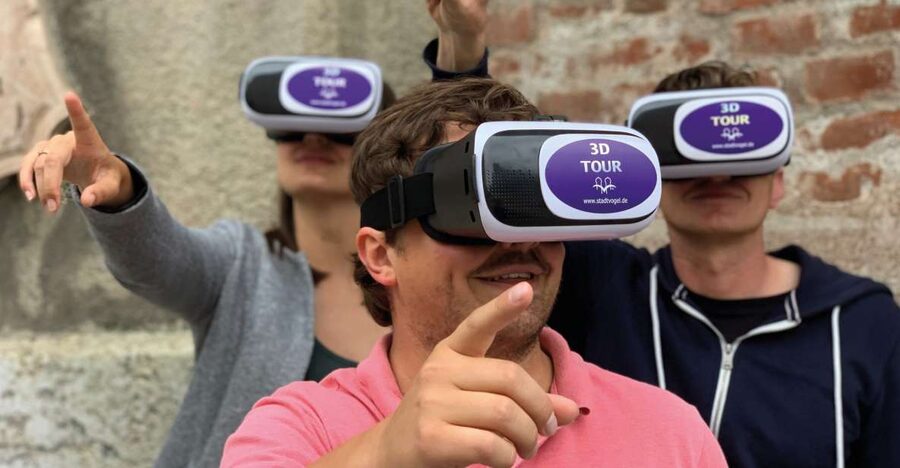
- Bring your own phone: You need a charged smartphone and internet access to download the app used with the VR glasses.
A time machine with its feet on the pavement
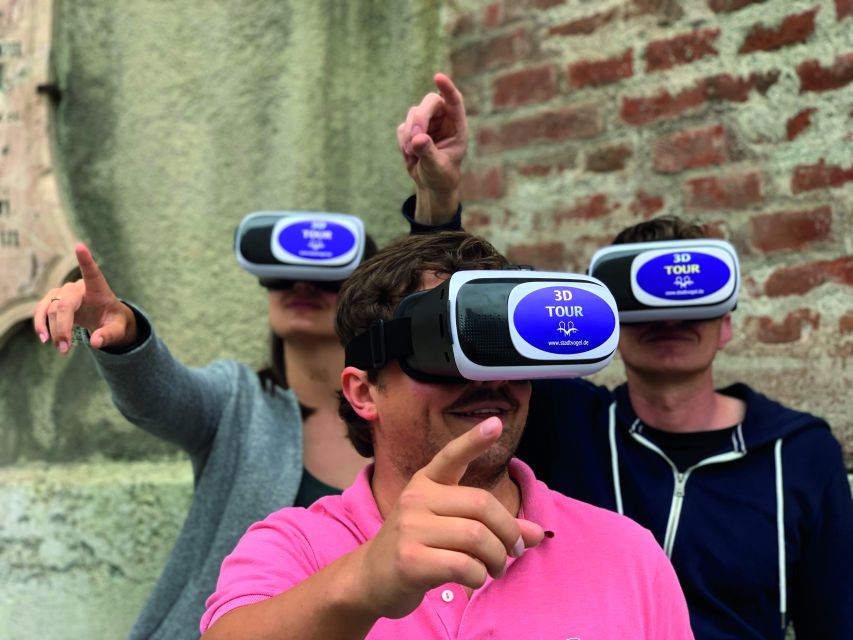
This is still a walking tour first. You move through Munich’s Old Town with a guide, hear stories about the places around you, and pause at four locations to view 3D renderings. The technology adds a visual layer, but it does not replace the streets, buildings, and guide-led explanation.
That distinction matters when you decide whether to book. If you expect a cinematic VR show with animated scenes, this may feel modest. The images are photographs or still views, not moving video, and you use your own smartphone inside the glasses. If you like seeing how a familiar square once looked while standing in the same place, the idea is more appealing.
The guide is central to the outing. The best parts are the stories that connect what you see in the image to what stands around you now: the old uses of Marienplatz, the changing character of Platzl, and the past and present of the Hofbräuhaus. The route gives you a way to notice details rather than simply walk from one landmark to the next.
The tour lasts two hours, long enough for a guided introduction without taking over an entire day. Its specific focus also makes it a useful choice if you have already seen the central sights and want a different angle on them. You are not being promised a wide sweep of Munich. Instead, you get a closer look at a small part of the Old Town across several periods.
More walking tours in Munich:
- Munich: Third Reich & WWII Walking Tour
★ 4.6 · 6,181 reviews - Third Reich Walking Tour Munich
★ 4.5 · 4,291 reviews - Munich: Old Town & Viktualienmarkt City Walk in German
★ 4.7 · 2,304 reviews
Marienplatz, first around 1570
The tour splits Marienplatz into two historical scenes. On the western side, the VR image takes you to 1570, when the square included a medieval grain market. That setting can help you picture the square as a place of trade and public life, rather than only as the polished center of modern Munich.
The more unsettling details are part of the story too. The square had gallows used for special executions and a so-called disgraceful donkey, a name that hints at the public shaming once used as punishment. These are memorable details, but they also make the past feel less like a quaint backdrop. A market square could be practical, ceremonial, and harsh all at once.
The image gives you a point of comparison while the guide fills in the human context. You can look from the old scene to the modern square and consider how much its role has changed. That is the tour’s strongest use of the technology: it gives you a visual prompt, then lets the guide explain what a flat image cannot.
Keep your expectations sensible. The image is not an animated reconstruction, and the glasses may not make every detail easier to see than your phone screen. Still, the combination of a specific year, a real location, and a guide’s account can make the stop more memorable than a quick glance at a landmark.
Marienplatz, then around 1870
The eastern side shifts the clock forward by roughly three centuries. The scene around 1870 shows what the old town hall looked like at an earlier stage, including the first completed part of the hall, as well as carriages and professions at work.
This second image is useful because it makes the square’s changes more legible. Rather than treating Marienplatz as one unchanging historic setting, you see it at two different points in time. The contrast also helps you think about how public buildings, transport, and everyday work shaped the center of the city.
Look beyond the main building in the image. The carriages and workers are part of the appeal, since they suggest how people used the square and what ordinary activity might have looked like. The guide’s explanations help tie those details to the present-day scene, so you can spot what is no longer there and what has endured.
The two Marienplatz stops are likely to be the clearest argument for booking if you enjoy urban history. They offer a paired comparison in the same location, not just a historical picture shown in isolation. If you are mainly seeking elaborate VR effects, though, the static format may feel underwhelming.
Platzl and the Hofbräuhaus
At Platzl, the tour moves to 1895. The guide explains how the area developed and how it became the old-Munich place you see today. This part adds a neighborhood-scale view to the larger civic square: you are looking at how a corner of town changed its identity over time.
The stop also includes the Hofbräuhaus, shown in past and present forms. It is a familiar name, but comparing an earlier view with the modern building gives the guide a chance to talk about continuity and change in a place that remains part of Munich’s public image.
The supplied details do not specify exactly what appears in every render or how long the group spends at each location. It is best to think of Platzl and the Hofbräuhaus as stops for guided context and visual comparison, rather than expect a detailed interior visit. Food and drinks are not included, and the tour description does not promise a meal stop.
These locations round out the route well. Marienplatz provides the clearest shift across centuries, while Platzl and the Hofbräuhaus bring the focus to places that still feel closely tied to Munich’s identity. If you have already walked through this part of town, the guide’s stories are what make a return visit worthwhile.
More history tours in Munich:
- Munich Old Town Walking Tour
★ 4.5 · 1,287 reviews - Munich: Spooky Tour of Old Town in German
★ 4.6 · 1,112 reviews - Munich: Walking Tour Old Town and Viktualienmarkt
★ 4.7 · 839 reviews - Munich: Old Town Walking Tour
★ 4.7 · 589 reviews
The guide matters more than the gadget
The tour’s strongest element is the human one. The guide leads the walk, explains the old and present-day city, and gives the images their context. German is the only stated tour language, so you should be comfortable following a live German-language explanation to get the full benefit.
The guide’s delivery has been described as warm, engaging, and full of enthusiasm. That is worth emphasizing because the technology is not guaranteed to impress. A lively guide can make a still image useful; a headset on its own cannot explain why a grain market, public punishment, or old trade mattered.
No guide’s name is provided, so you cannot request a particular person. You can, however, expect a live guide rather than an audio-only route. The outing is also listed as wheelchair accessible, a practical point for anyone checking whether the walk might suit their needs.
The VR glasses: useful, but keep expectations modest
The most important practical detail is that you supply the smartphone. At the meeting point, participants download an app and place the phone into the VR glasses to see the 3D images. Bring a charged phone and internet access; without those, you may not be able to use the viewing setup as intended.
The glasses are a simple way to frame the images, not a high-end virtual reality system. Some participants have found the pictures clearer on the phone itself, and there have been cases where a pair of glasses or a phone did not work. These are real limitations to weigh against the tour’s price.
The scenes are still images, not animated footage. That may disappoint you if you picture a fully moving reconstruction of medieval Munich. On the other hand, a still image can still help you compare a past version of a place with the street in front of you, especially when the guide points out what to notice.
If the image is difficult to see through the glasses, keep your phone accessible and be ready to view it directly. The tour depends on personal devices, so checking your battery before you arrive is a good idea. There is no mention of provided phones or a backup viewing device.
Is $37 a fair price for two hours?
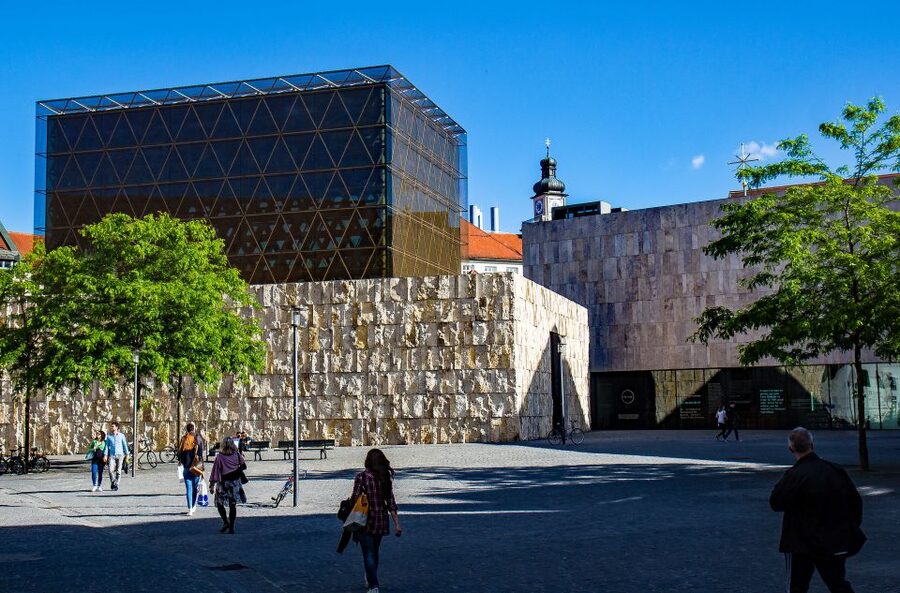
At $37 per person, you are paying for a guided two-hour walk, the VR glasses, and a focused historical interpretation of central Munich. You are not paying for transport, hotel pickup, food, or drinks. The value depends on how much you want the guide’s stories and whether the phone-based 3D element adds something for you.
If you would otherwise explore the Old Town on your own, the guide is the main reason to spend the money. You get a structured route, historical context for four locations, and details that are easy to pass by when you are simply navigating between sights. The two Marienplatz periods also give the walk a clear theme.
The price is harder to justify if the headset is your main reason for booking. The still images and occasional technical problems mean you should not value this like a polished VR attraction. Think of the glasses as an extra, with the guided walk as the core product.
The two-hour length helps the outing fit around other plans, though you should not expect it to cover all of Munich. It concentrates on the Old Town and the specific scenes at Marienplatz, Platzl, and the Hofbräuhaus. For a first visit, it can complement a broader city walk; for a repeat visit, it offers a narrower historical lens.
Meeting point and useful preparations
Meet your guide directly in front of the Orlandohaus at Platzl 4. Look for a large blue bag with the white words Weis(s)er Stadtvogel and a 3D Tour sign. Those details should make the meeting point easier to identify in this central area.
Before setting out, charge your smartphone and make sure you have internet access. You will download an app at the meeting point, then place your phone in the VR glasses. Since the guide speaks German, this is best suited to people who can follow a German-language walking tour.
The activity is listed as wheelchair accessible. Hotel pickup and drop-off are not included, and neither are food or drinks. Starting times depend on availability, so check the date you have in mind before planning the rest of your day around the two-hour walk.
Who should book this Munich walk?
I would consider this tour if you enjoy local history and want a guide to make well-known streets feel less familiar. It is particularly suited to visitors who are curious about how Marienplatz changed, who like concrete details about old trades and public life, or who enjoy trying modest new technology without expecting a full virtual-reality production.
Families and friends may find the shared activity fun, as the tour is designed for people to use the glasses while exploring together. The historical details also give the group plenty to talk about between stops. Keep in mind that the walk is in German, and the phone setup means everyone needs to prepare their own device.
You may want to skip it if you need an English-language tour, dislike using your phone for an activity, or expect animated VR scenes. It may also be less compelling if you have little interest in guided interpretation and would rather see the Old Town at your own pace.
My call: book it for the German-speaking guide and the historical comparisons, not for dazzling technology. If the idea of standing at Marienplatz while learning about its grain market, punishments, carriages, and changing buildings appeals to you, the two hours can be a worthwhile use of your time. Just arrive with a charged phone and realistic expectations of the glasses.
FAQ
How long is the tour?
The walking tour lasts two hours. Starting times vary, so check availability for your date.
What language is the tour conducted in?
The live guide speaks German. No other tour language is specified.
Where is the meeting point?
Meet directly in front of the Orlandohaus at Platzl 4. The guide carries a large blue bag marked Weis(s)er Stadtvogel and a 3D Tour sign.
Do I need to bring my own smartphone?
Yes. Participants download an app at the meeting point and place their smartphone into the VR glasses to view the images.
Should my phone be charged and connected to the internet?
Yes. A charged smartphone and internet access are listed as things to bring.
Are the VR scenes videos?
No. The scenes are still images, not moving video.
What is included in the price?
The price includes a guide, the walking tour, and VR glasses.
Are food, drinks, or hotel transfers included?
No. Food, drinks, hotel pickup, and hotel drop-off are not included.
Can I cancel, and is the tour wheelchair accessible?
The tour is listed as wheelchair accessible. You can cancel up to 24 hours in advance for a full refund, and a reserve-now, pay-later option is available.
Just added in Munich
- Private day trip from Munich to Eagle’s Nest, Salzburg and back★ 4.5 · 15 reviews
- Private Castle Tour from Munich: Neuschwanstein, Hohenschwangau, and Linderhof★ 4.5 · 12 reviews
- Private Eagle’s Nest Tour from Munich ending in Salzburg★ 5.0 · 8 reviews
- Private day trip from Munich to Salzburg and Hallstatt★ 4.5 · 17 reviews
- Private Day Trip from Munich to Neuschwanstein and Linderhof★ 4.0 · 11 reviews
- Private Day Trip from Munich to Eagle’s Nest and Hallstatt★ 4.5 · 9 reviews
- Private Day Trip Munich to Harburg, Dinkelsbuhl & Rothenburg★ 4.5 · 24 reviews
- Private day trip from Munich to Eagle’s Nest and Salzburg★ 4.5 · 9 reviews
Munich History Tours, compared.
Old Town & Viktualienmarkt City Walk in German
Read our review →

Mystic Munich – Sagas and Legends of the Old Town
Read our review →
Munich 3-Hour Segway Tour: Nazi Munich & Royal Architecture
Read our review →
Fall in Love with Munich in a Private Old Town Walking Tour
Read our review →Browse the lists this tour appears in