
Reviewed · MUNICH THIRD REICH TOURS
Munich: Third Reich and World War II Private Guided Tour
Munich’s Nazi past is woven into its streets, squares and former party buildings. This private walk follows the story from Marienplatz to Königsplatz, putting places such as Hofbräuhaus and the Feldherrnhalle into the difficult history of how National Socialism began and took hold.
I like that the route gives you specific places to connect with the history, rather than keeping the subject at the level of dates and speeches. I also like the option to extend the walk into the NS Documentation Center, where exhibits and a private guide can help put the city’s story in a wider context.
The main consideration is the length and price: the standard walk is three hours, while the museum option takes 4.5 hours, and the listed price is $311 per person. Check the duration for the option you choose, and consider whether a private guide is worth the extra cost for your group.
- Marienplatz sets the scene: Hear how Nazi propaganda used a central square that was heavily damaged in the 1945 bombings.
- Hofbräuhaus and the Beer Hall Putsch bring the story down to street level: See sites tied to the movement’s early years and failed 1923 coup attempt.
- Resistance is part of the route: Learn about the White Rose Group and the Monument to the Victims of National Socialism.
- Königsplatz closes the three-hour walk: The square was used for Nazi rallies and book burning.
- The 4.5-hour option adds the NS Documentation Center: Its photographs, documents, films and media stations broaden the story beyond the street.
- It is a private tour in five languages: English, German, French, Italian and Spanish are offered.
Munich’s streets tell a hard story
This is not a general sightseeing walk with a brief wartime aside. The focus is the rise and fall of National Socialism in Munich, including the city’s role in the movement, the resistance to it, and the destruction and liberation of 1945. You can ask questions as you go, which matters with a subject that rarely fits into a tidy explanation.
The private format is useful here. You are not following a large group through a fixed script, so you can spend more time on the parts you find most important. That does not make the history simple, but it gives you room to ask about the role of Munich’s citizens and the causes and consequences of the Nazi period.
The walk is led by a history guide, with tours available in five languages. One rating specifically praises a guide named Mireya, and the overall score is 4.8 from 20 reviews. That is an encouraging sign, though a small review pool cannot promise which guide you will get or how your own tour will feel.
Marienplatz: starting in the city’s public square
Meet your guide in front of hotel BEYOND by Geisel at Marienplatz 22, opposite St Peter. Do not go into the hotel: it is only the meeting point, and hotel staff are not informed about the tour. This is a practical detail worth getting right before you arrive.
Marienplatz is a fitting place to start. The square hosted Nazi propaganda events, and the reconstructed New Town Hall stands amid a city center that was badly damaged by bombing in 1945. Here, the guide can introduce Munich’s transformation into the capital of the National Socialist movement, while the surrounding buildings help make the scale of wartime destruction less abstract.
This opening also gives you a useful frame for the rest of the walk. Instead of treating the Nazi period as a story that happened somewhere else, you begin in the everyday heart of Munich, where public life, political spectacle and wartime loss meet.
More Third Reich and WWII tours in Munich:
- Munich: Third Reich & WWII Walking Tour
★ 4.6 · 6,181 reviews - Third Reich Walking Tour Munich
★ 4.5 · 4,291 reviews - Munich: Birthplace of the Third Reich Guided Walking Tour
★ 4.6 · 771 reviews
Hofbräuhaus and the party’s early years
From Marienplatz, the route reaches Hofbräuhaus am Platzl, one of Munich’s best-known beer halls. Its place on the tour is historical, not just atmospheric: the venue is associated with an early speech by Adolf Hitler and the founding of the National Socialist German Workers’ Party in 1920.
The guide connects the setting to the origin story of the party and its supporters. That context matters because a familiar beer hall can otherwise seem like a curious backdrop rather than a location linked to the movement’s beginnings. You will hear how political organizing took shape in Munich, and how the party’s early ambitions developed.
Keep in mind that the tour is a walking history lesson, not a visit built around food or drink. The value of this stop is the explanation of what happened here and why it mattered, not a special experience inside the beer hall.
The Beer Hall Putsch route to Feldherrnhalle
The walk then follows the route of the Beer Hall Putsch toward Feldherrnhalle and Odeonsplatz. The failed attempt to seize power in 1923 is one of the key episodes in Hitler’s rise, and seeing the locations on foot helps you understand the geography of the event rather than imagining it as a detached chapter in a book.
At Feldherrnhalle, the guide explains the Nazis’ attempt to storm the Bavarian Defense Ministry. The putsch failed, but the event became part of the movement’s later political story. The tour also links this period to Hitler’s writing of Mein Kampf, his political manifesto.
This is likely to be one of the most question-heavy parts of the walk. The route does not make the subject easier, but it does offer a clear way to follow the events from one place to the next. If you have read about the putsch before, you can ask how the local setting shaped the episode; if not, the guide can supply the basic sequence.
Remembering resistance and victims
The route includes the Monument to the Victims of National Socialism and introduces resistance groups, including the White Rose, led by five university students. This is an important counterweight to a tour that could otherwise focus too heavily on Nazi leaders, party offices and rallies.
The resistance story brings attention to people who opposed the regime from within Munich. It also gives you a chance to consider the risks of resistance and the choices individuals faced. The available details do not set out a long stop or a specific presentation format at the monument, so the depth of discussion will depend on the guide and your questions.
For me, the inclusion of both the monument and the White Rose is a strength. A tour of Nazi-era sites should not present power as the only story worth telling. Here, the route makes room for remembrance and opposition alongside the history of the regime.
More private tours in Munich:
- Munich Private Tour with a Local – Highlights & Hidden Gems
★ 5.0 · 469 reviews - Mike’s Neuschwanstein & Linderhof Private Tour from Munich
★ 5.0 · 197 reviews - Dachau Concentration Camp Private Tour by Train from Munich
★ 5.0 · 185 reviews - Neuschwanstein & Linderhof Castle Luxury Private Tour from Munich
★ 5.0 · 171 reviews
Führerbau and the Nazi use of power
Further along, you see former Nazi Party office buildings, including Führerbau, or the Führer’s Building. It is associated with the 1938 Munich Agreement, signed there by Hitler and Chamberlain. The guide uses these buildings to explain how Munich served the Nazi Party and how political decisions became tied to particular addresses.
Seeing a former office building from the street offers a different sort of historical encounter than entering a museum. The building remains part of the city, and the guide’s account helps you read its past without mistaking an imposing façade for the whole story. The tour description does not promise interior access, so plan on viewing these sites as part of the walk.
This stop also helps connect the early movement to the period when Nazi power was established. The route moves from origins and attempted seizure of power toward the structures and decisions of the regime itself.
Königsplatz: rallies, book burning and the end of the walk
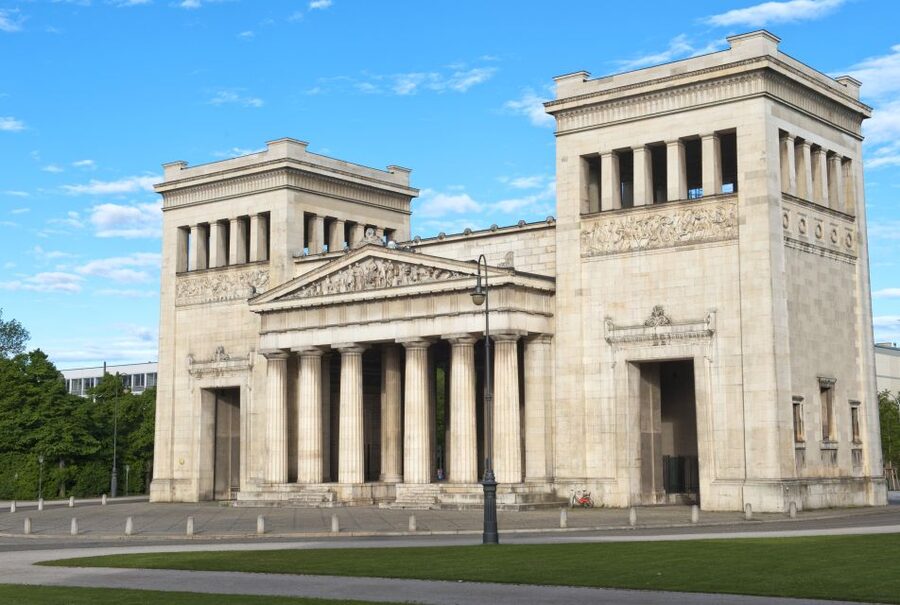
The standard three-hour walk ends at Königsplatz, a site used for mass rallies and book burning. It is a strong closing point because it brings together the public spectacle and ideological control that marked the Nazi era. The square’s place in the route gives the guide a chance to pull the earlier stops into a broader account of the movement’s rise and eventual fall.
By this point, you will have moved through early party history, the Beer Hall Putsch, resistance and the former party buildings. The order creates a practical timeline as well as a geographical walk. You finish with a clearer sense of how these separate places relate to one another across Munich.
The walk also addresses the city’s bombing and liberation in 1945. The New Town Hall’s reconstruction and the damage to downtown are part of that story, though the final stop is at Königsplatz rather than a dedicated wartime-destruction site.
The 4.5-hour option: the NS Documentation Center
If you want more than street-level history, choose the 4.5-hour option, which adds a visit to the Munich Documentation Center for the History of National Socialism with your guide. The center uses photographs, documents, texts, film projections and media stations to cover the movement’s origins and rise, the war, and Munich’s postwar period.
That museum visit is the clearest reason to choose the longer tour. The streets show you where events took place; the center supplies more evidence and a wider timeline. Having your guide with you can help you work through a subject that includes causes, political decisions, violence, resistance and consequences.
The tradeoff is time and intensity. Four and a half hours on a serious historical subject is a substantial commitment, so it may not suit you if you want a lighter introduction or have limited time in Munich. If the topic is a main reason for your visit, though, the additional exhibits make the longer option more useful than simply adding extra walking.
What the private format and price mean
At $311 per person, this is a significant expense, especially for an activity that is primarily a walking tour. Its value depends on whether you want a private guide focused on your questions and the Nazi-era history of Munich. If you are travelling with others who share that interest, the private format may make the cost easier to justify; if you are alone or mainly want a broad overview, compare the price with other ways to learn about the subject.
The longer option adds the NS Documentation Center, but the supplied price does not clarify whether the two durations have different prices. Check the selected option before booking rather than assuming the listed per-person figure covers both in the same way.
The tour is described as wheelchair accessible, and the live guide languages are English, German, French, Italian and Spanish. It is a private group, so you will not be sharing the walk with an unrelated party. Starting times depend on availability.
Who should book this Munich history walk?
I would choose this tour if you want a focused account of Munich’s role in the rise of National Socialism, especially if you value being able to stop and ask questions. The route is strongest when you want to connect major events to actual places, from Hofbräuhaus and Feldherrnhalle to Führerbau and Königsplatz.
Choose the 4.5-hour version if you want the street route and museum exhibits in one outing. The three-hour version is a better fit if you want a more contained introduction and are comfortable ending at Königsplatz without the Documentation Center.
Think twice if you are seeking a relaxed city stroll, a food-focused experience or an inexpensive overview. This is serious material, and the price is high for a walking tour. But if you want a private, site-specific history lesson and are ready to spend several hours with a difficult subject, it offers a clear, thoughtful way to understand the city’s past.
FAQ
How long is the tour?
The standard walking tour lasts three hours. A 4.5-hour option adds a visit to the Munich Documentation Center for the History of National Socialism.
Where does the tour meet?
Meet in front of hotel BEYOND by Geisel at Marienplatz 22, opposite St Peter. Do not enter the hotel, since it is only the meeting point.
Which languages are available?
The live tour is offered in English, German, French, Italian and Spanish.
Is the NS Documentation Center included?
The Documentation Center is included with the 4.5-hour option only. The standard three-hour tour does not include the museum visit.
Is the tour private and wheelchair accessible?
Yes. It is offered as a private group and is described as wheelchair accessible.
Can I cancel the tour?
You can cancel up to 24 hours in advance for a full refund. A reserve-now, pay-later option is also available.
Just added in Munich
- Private day trip from Munich to Eagle’s Nest, Salzburg and back★ 4.5 · 15 reviews
- Private Castle Tour from Munich: Neuschwanstein, Hohenschwangau, and Linderhof★ 4.5 · 12 reviews
- Private Eagle’s Nest Tour from Munich ending in Salzburg★ 5.0 · 8 reviews
- Private Day Trip from Munich to Eagle’s Nest and Hallstatt★ 4.5 · 9 reviews
- Private day trip from Munich to Salzburg and Hallstatt★ 4.5 · 17 reviews
- Private Day Trip from Munich to Neuschwanstein and Linderhof★ 4.0 · 11 reviews
- Private Day Trip Munich to Harburg, Dinkelsbuhl & Rothenburg★ 4.5 · 24 reviews
- Private day trip from Munich to Eagle’s Nest and Salzburg★ 4.5 · 9 reviews
Munich Third Reich Tours, compared.

Munich World War II Sites Including Dachau Concentration Camp
Read our review →
Munich City Walking Tour, includes Third Reich & Viktualienmarkt
Read our review →
Munich 3-Hour Segway Tour: Nazi Munich & Royal Architecture
Read our review →
Dachau Concentration Camp Memorial Site And Third Reich Day Tour From Munich
Read our review →
Eagle’s Nest-Berchtesgaden-Obersalzberg Private Half Day WWII Historical Tour
Read our review →Browse the lists this tour appears in