
Reviewed · MUNICH THIRD REICH TOURS
Third Reich & WWII Walking Tour
Munich’s Nazi past is not confined to a museum: this walking tour connects the places where the movement gathered, tried to seize power and staged mass rallies. I like that it pairs major political sites such as the Feldherrnhalle and Königsplatz with the story of the White Rose resistance, and that guides such as Josh, Alex and Michael are praised for handling difficult history with care.
The other practical plus is the route’s central start and finish, which makes it easy to fit into a Munich visit. The main consideration is the pace: expect close to three hours of walking and standing, with little time for a proper break. Bring water and a small snack, and check the meeting-point details carefully before setting off.
- Hofbräuhaus and the movement’s early meetings: Hear how Munich became a base for Nazi organizing.
- Feldherrnhalle: Learn about the failed 1923 attempt to seize power and the site’s later importance.
- Königsplatz: See where the Nazi Party held mass rallies and where the tour ends.
- Hofgarten and the White Rose: Consider the resistance story alongside the rise of dictatorship.
- A serious, guided walk: English commentary lasts about 2 hours 45 minutes, with a professional guide.
- Check the group-size details: The tour is described as limited to 10 in one place and capped at 30 in another.
Munich’s streets tell the story
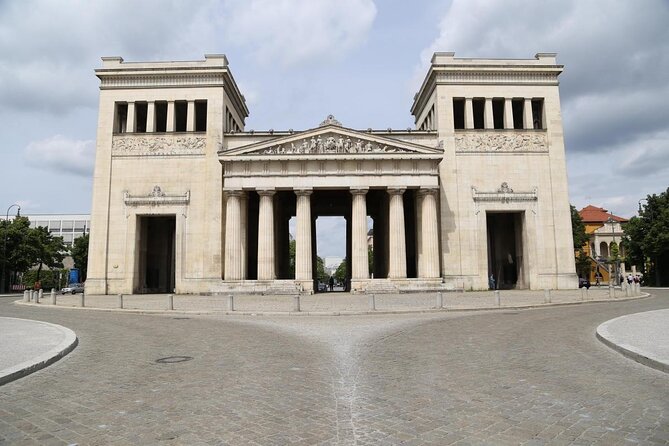
This tour is a ground-level introduction to how Munich became central to the Nazi movement. Rather than treating the Third Reich as a series of distant dates and leaders, it links political events to the city’s squares, buildings and public spaces. That setting helps make the history legible: you can see where crowds gathered and how a city’s familiar center became a stage for political power.
The tour begins at Marienplatz and ends at Königsplatz, taking about 2 hours 45 minutes. Its central subject is the movement’s growth, from early meetings at the Hofbräuhaus to the failed attempt to seize power at the Feldherrnhalle, then to rallies at Königsplatz. The guide also discusses the White Rose, a group that opposed the regime, at the Hofgarten.
Expect a substantial amount of information in a short time. The guides’ strength, based on the experience described by people who took the walk, is not just recalling dates. Alex, Josh, Michael, Ulrich, Danielle, Joel and Bridget are among the guides named, and visitors have praised their clear explanations, thoughtful handling of tragic events, and readiness to answer questions. The guide on your date may be someone else, but the tour’s value depends heavily on that live commentary.
From Marienplatz toward the Nazi movement’s beginnings
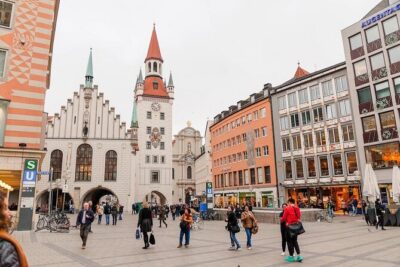
Marienplatz is the meeting point, in Munich’s central old town. The tour then places the city’s Nazi-era story against the upheaval that followed World War I. Germany had lost the war, while Munich and Bavaria faced revolution, political violence and economic turmoil. That context matters: it helps explain how a radical movement could gain support, without suggesting that its later crimes were inevitable or excusable.
The tour’s account follows the party’s growth through local sites and events. The Hofbräuhaus is associated with the movement’s first mass meeting, making it a useful place to consider how political organizing moved from small circles into public view. The point is not simply to tick off a famous beer hall. It is to understand how public gatherings and persuasive political messaging helped build a movement.
The route’s start at Marienplatz may not seem like the most obvious place to begin a tour focused on the Nazi Party. One person who took it felt Königsplatz would make a better starting point. But beginning in the city center can offer a broader orientation before the walk moves through the sites tied to the movement. The important practical detail is to confirm the exact meeting point: directions and map pins have caused confusion for some, so do not rely on a pin alone if the booking instructions offer clearer directions.
More Third Reich and WWII tours in Munich:
- Munich: Third Reich & WWII Walking Tour
★ 4.6 · 6,181 reviews - Third Reich Walking Tour Munich
★ 4.5 · 4,291 reviews - Munich: Birthplace of the Third Reich Guided Walking Tour
★ 4.6 · 771 reviews
Feldherrnhalle and the failed putsch
At the Feldherrnhalle, the story turns to the 1923 putsch, the Nazis’ failed attempt to seize power. This stop gives the guide a chance to explain how an unsuccessful act of political violence became part of the movement’s public story. It is one of the walk’s most important sites, not because it marks a victory, but because it shows how the Nazis used the memory and symbolism of political events.
A good guide will connect the physical place with the events and their consequences, while leaving space for questions. Josh and Alex, in particular, have been praised for giving detailed context and inviting discussion. You do not need to arrive with a strong background in German history, though the pace and amount of information may feel dense if this is your first serious encounter with the period.
The subject is heavy. Guides have been described as factual and respectful, allowing quiet moments as well as conversation. That approach is welcome here. The point is not to turn a grim chapter into spectacle, but to understand how it unfolded and what its locations came to mean.
Hofgarten and the White Rose resistance
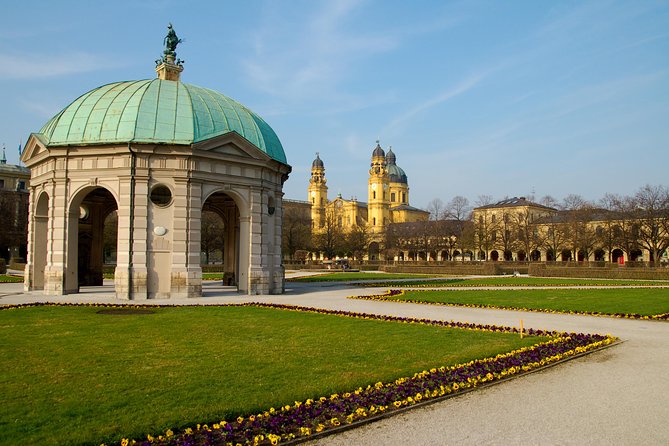
The Hofgarten stop widens the story beyond the Nazi rise to power. Here, the guide discusses the White Rose resistance movement, bringing the choices of people who opposed the regime into the tour. This is an important counterpoint to the political rallies and attempted coup: it makes clear that not everyone accepted the dictatorship, even as resistance carried grave risks.
The stop also encourages reflection on how people remember this period today. Guides have connected Munich’s local history with the broader question of how societies respond to propaganda, group pressure and loud political voices. That is useful context, especially if you are visiting sites connected to Nazi power and want more than a list of dates and names.
The tour is outdoors and keeps moving between locations, so expect to listen while standing. There is little time for a substantial rest, and one account describes a short indoor pause during a cold-weather tour. Do not count on that break as a fixed feature. Dress for the forecast, wear shoes you can walk and stand in, and bring water and a snack.
Königsplatz and the scale of public spectacle
Königsplatz is one of the tour’s central stops and its endpoint. The square was used for mass Nazi Party rallies, and its scale helps explain how public space could be put to political use. Here, the guide can tie together the movement’s early organizing, its attempt to seize power and its later use of large gatherings to project authority.
The tour description identifies Königsplatz 1 as the end point and says the walk ends at Hitler’s former headquarters. The precise relationship between the endpoint and the former headquarters is best clarified with your guide on the day, but the destination places you among the city’s key sites connected to Nazi rule. You can use the end of the walk to ask follow-up questions and decide what else you want to see.
One guide also suggested visiting a document museum after the tour. That can be a worthwhile next step if you want more time with the subject, but it is separate from the walking tour. The walk itself is an outdoor overview, not a museum visit, and no admission ticket is included.
More walking tours in Munich:
- Munich: Old Town & Viktualienmarkt City Walk in German
★ 4.7 · 2,304 reviews - Munich: Night Watchman Walking Tour
★ 4.7 · 2,092 reviews - Munich Ghosts and Spirits Evening Walking Tour
★ 5.0 · 1,900 reviews - Munich Old Town Walking Tour
★ 4.5 · 1,287 reviews
What the pace and group size mean
At roughly 2 hours 45 minutes, this is not a quick orientation stroll. You will cover several sites and hear a concentrated account of Munich’s role in the Nazi era. One description says the tour is limited to 10 people, while the additional information gives a maximum of 30. That discrepancy matters: a group of 10 can make it easier to hear and ask questions, while a group closer to 30 may feel less personal. Confirm the expected size before booking if that is a deciding factor.
Some people have found the guide hard to hear, especially in busy or crowded surroundings. If you have hearing concerns, position yourself near the guide and ask at the start whether there is amplification. The tour is described as suitable for most participants, but you should be comfortable walking and standing for an extended period. The route is not recommended for children under 12.
Weather can shape the experience. The walk has continued in cold conditions, and guides have kept groups engaged despite the chill. Still, three hours outside can feel long if you are underdressed. A warm layer, comfortable shoes, and a drink are sensible basics.
Is $35.09 good value?
At $35.09 per person, the price buys a professional guide and a structured account of several major sites, rather than admission to attractions or a meal. The value is in the connections: a guide can link locations that might otherwise look like ordinary squares and streets, and can explain why they mattered in the rise and rule of the Nazi Party.
The cost is easier to justify if you have a real interest in modern German history, or if you want a strong introduction before exploring further on your own. It is also helpful if you value the chance to ask questions and get local suggestions. Alex, Josh and other named guides have been praised for giving practical ideas for museums, landmarks and places to eat or rest after the walk.
It is less compelling if you want a light sightseeing tour, a relaxed pace with long breaks, or entry to a museum included in the price. Food, drinks and hotel pickup or drop-off are not included. The tour is booked an average of 22 days in advance, so it is worth planning ahead, especially if you want a particular date.
Who should book this Munich history walk?
I would choose this tour if I wanted a clear, site-based account of Munich’s role in the Nazi movement and a guide who can put the facts into context. It suits adults and older children who are prepared for serious subject matter, steady walking and a dense stretch of historical explanation. You do not need prior expertise, but an interest in the period will help you absorb the detail.
The strongest reason to book is the combination of landmarks and interpretation: Hofbräuhaus, Feldherrnhalle, Königsplatz and the Hofgarten each illuminate a different part of the story. The main reasons to pause are the long time on your feet, possible group-size uncertainty and the need to verify the precise Marienplatz meeting point.
If those trade-offs suit you, this is a worthwhile way to understand why Munich matters in the history of the Third Reich. Bring a drink, check the directions before you leave, and save time afterward if you want to follow up at a museum or ask your guide for more local recommendations.
FAQ
How long does the tour take?
It lasts approximately 2 hours 45 minutes. Plan for close to three hours, including time spent walking and listening at the stops.
Where does the tour start?
It starts at Marienplatz, 80331 München, Germany. Check the detailed meeting instructions before you go, since the map pin may not make the exact location clear.
Where does the tour end?
It ends at Königsplatz 1, 80333 München, Germany. The stated end point is near Hitler’s former headquarters.
What language is the tour offered in?
The tour is offered in English.
What sites are included?
The tour covers sites associated with Munich’s Nazi history, including the Hofbräuhaus, Feldherrnhalle, Königsplatz and the Hofgarten, where the guide discusses the White Rose resistance movement.
How many people are in the group?
The tour is described as limited to 10 people in its highlights, while the additional information states a maximum of 30. Confirm the group size with the provider if this is important to you.
Is the tour suitable for children?
It is not recommended for children under 12.
What is included in the price?
A professional guide is included. Food, drinks, hotel pickup and drop-off are not included, and admission tickets are not included.
Can I cancel for a refund?
Yes. You can cancel at least 24 hours before the experience’s start time for a full refund. Cancellations or changes made less than 24 hours beforehand are not accepted for a refund.
Just added in Munich
- Private day trip from Munich to Eagle’s Nest, Salzburg and back★ 4.5 · 15 reviews
- Private Castle Tour from Munich: Neuschwanstein, Hohenschwangau, and Linderhof★ 4.5 · 12 reviews
- Private Eagle’s Nest Tour from Munich ending in Salzburg★ 5.0 · 8 reviews
- Private Day Trip from Munich to Eagle’s Nest and Hallstatt★ 4.5 · 9 reviews
- Private day trip from Munich to Salzburg and Hallstatt★ 4.5 · 17 reviews
- Private Day Trip from Munich to Neuschwanstein and Linderhof★ 4.0 · 11 reviews
- Private day trip: Munich to Neuschwanstein Castle, local driver★ 4.5 · 3 reviews
- Private Day Trip Munich to Harburg, Dinkelsbuhl & Rothenburg★ 4.5 · 24 reviews
Munich Third Reich Tours, compared.

Munich World War II Sites Including Dachau Concentration Camp
Read our review →
Munich City Walking Tour, includes Third Reich & Viktualienmarkt
Read our review →
Munich 3-Hour Segway Tour: Nazi Munich & Royal Architecture
Read our review →
Dachau Concentration Camp Memorial Site And Third Reich Day Tour From Munich
Read our review →
Eagle’s Nest-Berchtesgaden-Obersalzberg Private Half Day WWII Historical Tour
Read our review →Browse the lists this tour appears in